




October 27, 2026
Reflecting a surge in orders for transportation equipment, the Commerce Department released a report on Tuesday showing an increase in new orders for U.S. manufactured durable goods in September. The Commerce Department said durable goods orders jumped by 1.8% in September following a 0.1% uptick in August. The sharp increase in durable goods orders came as orders for transportation equipment spiked by 4.6% in September after slipping by 0.3% in August. Orders for non-defense aircraft and parts increased by 28.4% in September after rising by 0.3% in August.
Excluding the surge in orders for transportation equipment, durable goods orders climbed by 0.5% in September after rising by 0.3% in August. Ex-transportation orders were expected to increase by 0.6%. The report showed notable growth in orders for machinery, computers, and electronic products, while orders for electrical equipment, appliances, and components fell. The Commerce Department also said orders for non-defense capital goods excluding aircraft, a key indicator of business spending, increased by 0.5% in September after jumping by 1.6% in August. Shipments in the same category, which is the source data for equipment investment in GDP, shot up by 1.2% in September after climbing by 0.6% in August. 10/27/2026 - 10:12:00 (RTTNews)
Consumer confidence in the U.S. has seen a substantial improvement in October. The consumer confidence index jumped from 84.2 in September to 91.7 in October. The present situation index, which is based on consumers' assessment of current business and labor market conditions, increased from 111.8 in September to 120.4 in October. The expectations index, which is based on consumers' short-term outlook for income, business, and labor market conditions, also surged from 65.7 in September to 72.6 in October. 10/27/2026 - 10:59:00 (RTTNews)
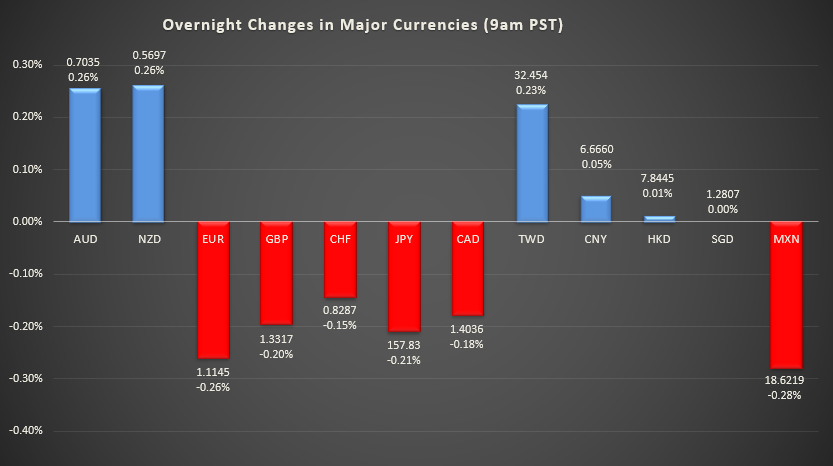
Euro traded at 1.1145 against USD at 9:00 AM PST
Spain's unemployment rate rose to a double-digit level in the third quarter. The jobless rate came in at 10.18% in the third quarter, up from 9.87% in the preceding period. In the same period last year, the unemployment rate was 10.45%. Unemployment increased by 95,900 to 2.59 million in the third quarter. At the same time, the number of employed people increased by 73,600 from the prior quarter to 22.85 million. Employment gains were concentrated in the services sector, which added 235,600 jobs. Meanwhile, agriculture shed 58,300 positions, industry lost 54,400 jobs, and construction reported a fall of 49,300. 10/27/2026 - 08:24:00 (RTTNews)
French consumer confidence declined to its lowest level in more than 13 years in October amid bond selloffs and expanding protests, signaling pressure on spending. The consumer confidence index fell from 85 in September to 80 in October. A similar lower score of 85 was last reported in June 2013. Assessment of past and future personal financial situation deteriorated notably in October. The past personal financial situation indicator dropped six points to -32, and the one related to future slid nine points to -24.
Household sentiment regarding standard of living declined again. The past standard of living index hit -85, the lowest since 1972. The future standard of living index dropped from -61 to -67. The proportion of households that believe it is a good time, in the current economic situation, to make major purchases weakened after a moderate improvement. The corresponding indicator fell from -37 to -41. The proportion of households that believe it is a good idea to save declined again, with the balance easing from 43 in September to 37.
At the same time, the index measuring future ability to save decreased again, from 15 to 12. Meanwhile, the current saving capacity indicator remained unchanged at 17. Further, household fears about unemployment increased. The balance climbed five points to 61. Price concerns intensified among consumers. The share of households that believe prices have risen over the past twelve months increased sharply, with the index up eight points to 42. 10/27/2026 - 06:36:00 (RTTNews)
British Pound traded at 1.3317 against USD at 9:00 AM PST
United Kingdom shop price inflation accelerated to its highest level in two and a half years in October. The shop price index climbed 2.1% year-on-year in October, faster than the 1.4% increase seen in September. Non-food inflation increased from 0.8% to 1.7%, while food inflation increased from 2.5% in September to 2.9%. Despite retailers delivering plenty of promotions on sweet treats ahead of Halloween, food inflation increased again, and non-food inflation climbed to an almost three-year peak. 10/27/2026 - 04:09:00 (RTTNews)
China's industrial profits increased notably in September, underpinned by robust growth in electronic and high-tech manufacturing. Industrial profits logged a year-on-year growth of 14.4% in September, following the prior month's 4.2% expansion. Industrial profits rose 15.5% from the same January to September period last year but slower than the 15.7% rise registered in the January to August period. Driven by demand for AI computing power and data storage, profits in high-tech manufacturing advanced almost 52% from last year. 10/27/2026 - 03:44:00 (RTTNews)
国泰银行准备的此市场最新讯息仅供参考,不构成任何形式的法律、税务或投资建议,也不应被视为对未来汇率变动或趋势的保证或担保。提供此信息时没有考虑任何接收者的特定目标、财务状况或需求。国泰银行对本市场最新讯息的准确性、完整性或充分性不做任何表述或保证。
